

Occupational therapy assistants (OTAs) represent a healthcare profession with substantial growth potential. These professionals earn an average of $66,050 per year or $31.76 per hour while helping people transform their lives. The author’s experience demonstrates how this career path combines job security with a deep sense of purpose.
The future looks bright for OTAs. Employment opportunities are projected to grow by 21% from 2023 to 2033, outpacing most other occupations. Throughout their career, the author has worked with patients of all ages at hospitals, rehabilitation centers, skilled nursing homes, schools, and patients’ homes. OTAs serve as hands-on partners who turn therapy care plans into real-life outcomes, making them vital members of the healthcare team.
This piece reveals the reality of an OTA’s duties, certification requirements, and daily responsibilities. Readers will learn everything needed to consider this rewarding career path. The insights derive from the author’s daily professional experiences, whether readers are exploring healthcare careers broadly or specifically learning what certified occupational therapy assistants do.
What is an Occupational Therapy Assistant?
As an allied health professional, an occupational therapy assistant (OTA) helps people regain independence and live better lives. The author has witnessed firsthand how this profession transforms patients’ lives throughout their career.
Definition and role of an OTA
Occupational therapy assistants work under licensed occupational therapists (OTs) in healthcare settings. They help people develop, regain, improve, and maintain skills needed for daily living and working after facing illness, injury, or disability. Their primary goal is enabling participation in meaningful activities—from dressing independently to returning to work or enjoying hobbies.
The core responsibilities of an OTA include:
- Implementing treatment plans developed by occupational therapists
- Guiding clients through therapeutic activities and exercises
- Teaching patients to use adaptive equipment
- Documenting progress and providing feedback to the OT
- Offering encouragement and emotional support
- Preparing safe therapy environments
- Maintaining detailed session records
OTAs constitute approximately 24% of occupational therapy professional jobs in the United States, underscoring their importance in the healthcare ecosystem amid rapidly growing rehabilitation services.
Difference between OTA and OT
OTAs and OTs collaborate as a team, but key differences exist. Education requirements represent the most significant distinction: OTs must complete a master’s degree (typically four years), while OTAs earn an associate degree in about two years.
Scope of practice further differentiates the roles. OTs evaluate patients and create treatment plans, whereas OTAs execute these plans through direct patient interaction. OTs practice independently, while OTAs require OT supervision.
Daily tasks also vary. OTs focus on evaluations and goal-setting, while OTAs concentrate on therapy activities. OTAs often manage larger caseloads at some facilities due to OTs’ administrative responsibilities. OTs earn approximately $31,000 more annually than OTAs, reflecting their additional education and responsibilities.
What is a certified occupational therapy assistant?
A Certified Occupational Therapy Assistant (COTA) has completed an accredited program and passed the National Board for Certification in Occupational Therapy (NBCOT) examination. This certification signifies more than technical proficiency—it demonstrates steadfast dedication to values enabling independence and human dignity in occupational therapy practice. The COTA credential verifies adherence to professional standards and effective support of therapeutic interventions.
Most states require passing the NBCOT exam and earning COTA credentials for licensure. Many states also mandate continuing education for license renewal, ensuring COTAs remain current with best practices. While certification renewal is optional in most states, Hawaii and South Carolina require it for license renewal.
The author’s experience as a certified OTA has opened doors to diverse career opportunities. Clients express greater confidence in their care when working with a certified professional.
What does an Occupational Therapy Assistant do daily?

Image Source: Stanbridge University
The author’s experience reveals that each OTA workday brings unique challenges and heartwarming moments while helping clients regain independence. A typical workday involves:
Assisting with therapy activities
OTAs primarily execute treatment plans designed by occupational therapists. Patients receive guidance through exercises, stretching, and practical activities that improve daily functioning. For example, stroke survivors engage in hand-strengthening exercises with therapy putty to rebuild fine motor skills. Children with developmental delays or ADHD respond well to playful activities like pattern-following games with colorful blocks to improve focus and hand control.
Every therapy session is tailored to individual needs. Some days involve helping elderly patients practice safe wheelchair-to-toilet transfers; others focus on teaching children with autism self-regulation techniques through sensory activities. These hands-on interactions form the foundation of an OTA’s daily duties.
Using adaptive equipment with patients
A significant portion of an OTA’s role involves training patients to use adaptive devices that enhance independence. These range from simple tools (reachers, walkers, sock aids) to complex systems (eye-gaze technology, augmented communication boards).
Patient assessment precedes any assistive technology recommendation. OTAs evaluate abilities, limitations, and environmental factors before providing proper training. For instance, someone recovering from hip surgery learns to use a long-handled shoehorn to put on socks without bending. The right equipment dramatically improves quality of life, enabling clients to maintain independence despite disabilities.
Documenting patient progress
Each session concludes with detailed records of patient progress, noting improvements or challenges. Thorough documentation demonstrates clinical reasoning and creates a comprehensive service record.
The author’s documentation includes:
- The client’s subjective status and emotional state
- Objective measurements and observations
- Performance assessment
- Plans for future sessions
These records help evaluate treatment effectiveness and facilitate communication with occupational therapists and other healthcare team members. Accurate documentation also ensures legal compliance and supports insurance claims.
Supporting emotional and physical recovery
A deeply rewarding aspect of the OTA role involves providing emotional support alongside physical assistance. Building rapport with clients creates a comfortable healing environment. Patients managing mental health challenges benefit from mindfulness techniques or art therapy to improve emotional well-being.
Recovery often involves discouragement. OTAs celebrate small victories and establish achievable goals to build confidence. By focusing on abilities rather than limitations, they promote resilience—especially crucial for those recovering from trauma or adjusting to permanent disabilities.
Though daily challenges vary, witnessing clients reach recovery milestones makes this career profoundly rewarding.
How to become an OTA in 2025
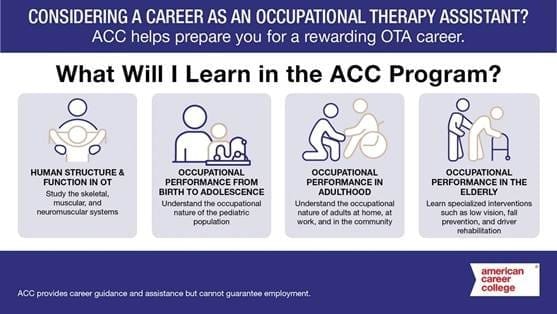
Image Source: American Career College
Becoming an occupational therapy assistant requires dedication, proper education, and certification. The path involves four key steps:
Step 1: Enroll in an accredited OTA program
Prospective OTAs must enroll in a program accredited by the Accreditation Council for Occupational Therapy Education (ACOTE). Most complete an associate degree, though bachelor’s options exist. Current data shows 207 accredited associate-level and 7 bachelor-level OTA programs nationwide.
Curricula typically cover:
- Anatomy and physiology
- Psychology and medical terminology
- Joint motion, posture, and balance techniques
- Common diseases and treatment approaches
Need help picking the right program? Call us at (800) 804-9961 to get guidance on selecting the best accredited program for your career goals.
Step 2: Complete required fieldwork
OTA students must complete at least 16 weeks of Level II fieldwork, providing immersive experience in delivering occupational therapy services. This hands-on training may occur across multiple practice settings.
Fieldwork allows students to apply classroom knowledge in clinical environments under supervision. Completion is required within 18 months of finishing academic coursework, with at least 8 hours of direct weekly supervision.
Step 3: Pass the NBCOT exam
After education and fieldwork, candidates must pass the National Board for Certification in Occupational Therapy (NBCOT) exam to earn COTA certification. Preparation strategies include:
- Creating a MyNBCOT account for study tools
- Reviewing the exam content outline thoroughly
- Utilizing resources like the NBCOT StudyPack (rated effective by 94% of students)
- Scheduling the exam at a Pearson Professional Center
Step 4: Get licensed in your state
NBCOT certification qualifies candidates to apply for state licensure. Requirements vary by state but typically include:
- Submitting an application with NBCOT certification proof
- Paying applicable fees
- Completing background checks (required in many states)
- Passing a state jurisprudence exam where mandated
Certification demonstrates national recognition of qualifications, while licensure grants legal permission to practice in a specific state. Most states require both before independent practice.
Where do OTAs work and who do they help?

Image Source: Concorde Career College
The author’s professional journey has spanned diverse healthcare settings, each offering unique opportunities to help people overcome challenges.
Common work settings:
OTAs practice in varied environments:
- Hospitals: Address acute cases requiring intensive therapy, often including night/weekend shifts.
- Schools: Follow academic calendars with time off during holidays.
- Homes: Help clients perform daily functions like dressing, meal preparation, and light housekeeping.
- Private therapy offices: Employ 47% of OTAs, often sharing space with OTs, physical therapists, and speech therapists.
OTAs also work in rehabilitation centers, nursing facilities, community settings (e.g., shelters), and specialized environments like airports or military bases.
Types of clients:
OTAs serve clients across all life stages:
- Children: Develop fine/gross motor skills for conditions like autism, Down syndrome, or developmental delays.
- Adults: Recover from injuries, manage chronic conditions, or adapt to life changes.
- Seniors: Focus on independence and quality of life through tailored care plans for aging-related challenges.
Conditions treated by OTAs
OTAs assist clients with diverse conditions:
- Physical challenges (spinal injuries, stroke, Parkinson’s disease)
- Developmental conditions (ADHD, cerebral palsy, sensory processing disorders)
- Mental health issues (depression, anxiety)
Regardless of setting or condition, OTAs make meaningful differences through their versatile expertise.
OTA salary, job outlook, and career growth
Financial rewards provide valuable insight into this career path.
Average salary in 2025
Certified occupational therapy assistants earn an average hourly wage of $29.35. The median annual salary reached $68,340 in May 2024, with top performers (75th percentile) earning up to $77,290. Geographic location significantly impacts earnings—California leads with average salaries of $85,877, followed by New York at $77,830.
Want to explore a career change? Call us today at (800) 804-9961 and let’s talk about how OTA salaries in your area match your financial goals.
Job demand and growth rate
The field projects robust growth of 18–25% from 2023 to 2033—far exceeding the 4% average for all occupations. Approximately 7,900 OTA job openings are expected annually over the next decade, driven by an aging population and medical advances enabling survival from previously fatal conditions.
Opportunities for specialization and advancement
OTAs can enhance careers through specializations in gerontology, pediatrics, physical rehabilitation, or hand therapy. Advancement paths include managing therapy departments and mentoring new therapists, expanding both expertise and earning potential.
Conclusion
The author’s experience as an occupational therapy assistant reveals a profession offering profound personal fulfillment alongside job stability. Helping clients achieve independence creates meaningful connections that transcend typical healthcare roles. With projected employment growth of 21% through 2033, specialized OTA skills remain in high demand across hospitals, schools, private practices, and rehabilitation centers.
Financial benefits complement emotional rewards. OTAs earn an impressive average of $66,050 annually, with top performers earning substantially more—especially in high-demand states. The relatively short educational pathway (typically a two-year associate degree plus certification) provides accessible entry into healthcare compared to many medical professions.
The diversity of experiences makes this career uniquely engaging. One day might involve helping a stroke patient relearn daily tasks; the next could focus on developing motor skills with children facing developmental delays. This variety sustains professional engagement over time.
Prospective OTAs should recognize that success requires both technical competence and genuine compassion. Patients place trust in OTAs during vulnerable moments while working toward greater independence. The NBCOT certification process provides essential knowledge, while fieldwork delivers critical hands-on preparation.
Though challenging at times, few professions combine job security, competitive compensation, and the daily opportunity to transform lives. Whether starting a first career or seeking meaningful change, occupational therapy assisting deserves serious consideration—it is work that truly matters.
Key Takeaways
Here are the essential insights about becoming an occupational therapy assistant and what this rewarding healthcare career offers:
- OTAs earn $66,050 annually with 21% job growth projected through 2033—among healthcare’s fastest-growing fields.
- Certification requires a 2-year associate degree, 16 weeks of fieldwork, NBCOT exam passage, and state licensure.
- OTAs work hands-on with diverse clients—from children with autism to stroke survivors—facilitating independence in daily activities.
- Career opportunities span hospitals, schools, rehab centers, and homes, with specialization options in pediatrics, gerontology, or hand therapy.
- Unlike occupational therapists (who evaluate and create treatment plans), OTAs implement therapy activities under supervision.
This profession delivers job security, competitive compensation, and profound satisfaction through helping people overcome challenges. Its accessible educational pathway makes it an ideal entry point for those seeking meaningful healthcare work with excellent growth prospects.
FAQs
Q1. What exactly does an occupational therapy assistant do on a daily basis? Occupational therapy assistants implement treatment plans designed by occupational therapists. They guide patients through therapeutic activities, teach the use of adaptive equipment, document progress, and provide emotional support. Daily tasks may include helping stroke survivors with hand exercises, assisting children with developmental delays, or teaching seniors how to safely perform daily activities.
Q2. How much can I expect to earn as an occupational therapy assistant? As of 2025, occupational therapy assistants earn an average annual salary of $66,050, or about $31.76 per hour. Top performers can make up to $77,290 per year. Salaries vary by location, with states like California and New York offering higher pay rates.
Q3. What education is required to become an occupational therapy assistant? To become an occupational therapy assistant, you need to complete an accredited OTA program, typically a two-year associate degree. This is followed by 16 weeks of fieldwork, passing the National Board for Certification in Occupational Therapy (NBCOT) exam, and obtaining state licensure.
Q4. How does the job outlook for occupational therapy assistants look in the coming years? The job outlook for occupational therapy assistants is very positive. Employment is projected to grow by 21% from 2023 to 2033, which is much faster than the average for all occupations. This growth is driven by an aging population and advances in medical treatments.
Q5. What’s the difference between an occupational therapist and an occupational therapy assistant? While occupational therapists (OTs) and occupational therapy assistants (OTAs) work together, their roles differ. OTs require a master’s degree and are responsible for evaluating patients and creating treatment plans. OTAs typically have an associate degree and focus on implementing these plans and working directly with patients under an OT’s supervision.
References
[1] – https://www.ncbi.nlm.nih.gov/books/NBK560554/
[2] – https://www.goodwin.edu/enews/where-do-occupational-therapy-assistants-work/
[3] – https://acoteonline.org/frequently-asked-questions/
[4] – https://acoteonline.org/all-schools/
[5] – https://www.brooklinecollege.edu/blog/a-day-in-the-life-of-an-occupational-therapy-assistant-ota/
[7] – https://www.usa.edu/blog/occupational-therapy-activities/
[8] – https://www.uws.edu/blog/occupational-therapy-expanding-role/
[10] – https://www.aota.org/practice/practice-essentials/documentation
[13] – https://www.joyce.edu/blog/ota-daily-routine/
[14] – http://sac.edu/AcademicProgs/HST/OTA/Pages/Fieldwork.aspx
[15] – https://www.nbcot.org/get-certified
[16] – https://www.aota.org/career/state-licensure/learn-the-steps-to-licensure
[17] – https://www.southuniversity.edu/news-and-blogs/2023/05/5-options-for-occupational-therapy-assistants
[18] – https://www.webmd.com/a-to-z-guides/what-is-occupational-therapy-assistant
[19] – https://www.payscale.com/research/US/Job=Certified_Occupational_Therapy_Assistant_(COTA)/Hourly_Rate
[20] – https://www.bls.gov/ooh/healthcare/occupational-therapy-assistants-and-aides.htm
[21] – https://careers.usnews.com/best-jobs/occupational-therapy-assistant/salary
[22] – https://careercenter.natsap.org/salary/occupational-therapy-assistant-ota
[23] – https://otaonline.stkate.edu/what-does-an-ota-do/cota-career-outlook/
[24] – https://www.centralpenn.edu/news/10-reasons-to-start-a-career-as-an-occupational-therapy-assistant/
